You have launched your startup, the website is live, the Instagram page is posting regularly — but what is your direct line to customers? Your email list. Social media algorithms can change overnight; an email list is an asset you own outright. That is why experienced founders start capturing emails from day one.
The real question for an Indian startup on a tight budget: of the dozens of email tools out there, which one actually fits an early-stage budget and workflow? This guide compares three widely used options — GetResponse, Kit (formerly ConvertKit) and Systeme.io — based on analysis of public specs, third-party reviews and pricing reads taken in 2026. No fake “we tested it ourselves” claims — just verifiable facts and honest positioning.
What does a startup actually need from an email tool?
Before comparing tools, it helps to be precise about what an early-stage startup really needs:
- A free or cheap entry point. When revenue is zero, every rupee counts. A genuinely usable free tier is ideal for the validation phase.
- Simple setup. You do not have a marketing team — the founder is the marketing team. The tool should work without a tutorial marathon.
- Basic automation. Welcome sequences and auto-replies for new subscribers save real effort from day one.
- A clear upgrade path. You may have 100 subscribers today and 10,000 next year. The tool should grow with you instead of punishing you for growing.
- Language flexibility. If your audience is comfortable in Hindi, the form builder and email editor must handle Hindi text (Roman or Devanagari) without breaking.
GetResponse vs Kit vs Systeme.io: comparison
| Factor | GetResponse | Kit (ConvertKit) | Systeme.io |
|---|---|---|---|
| What it is | Email marketing + automation platform | Creator-focused email tool | All-in-one marketing platform |
| Free plan | 500 contacts, 2,500 emails/month (functions like a starter demo) | Free up to 10,000 subscribers, unlimited broadcasts | Free forever: 2,000 contacts, unlimited sends, no credit card |
| Ease of use | Feature-rich, moderate learning curve | Simplest of the three — built for creators | Simple, single dashboard |
| Automation | Strong: workflows, segmentation, abandoned-cart | Visual automations; free-plan automation access is disputed — verify current terms | 1 automation rule + 1 workflow on free plan |
| Standout extras | Webinars, course builder, ecommerce tools | Paid newsletters, digital product sales, landing pages | Sales funnels, course hosting, website builder, blog |
| Paid plans from | ~$19/month (1,000 contacts, third-party read of official pricing) | $39/month (1,000 contacts, Creator plan) | Paid tiers available (check official pricing page — third-party figures conflict) |
| Best for | Automation-heavy marketing | Newsletter creators and educators | Budget startups wanting email + funnels in one place |
Pricing changes often, so treat every number above as a snapshot verified on 2026-10-09 and re-check the official pricing page before paying.
The free plans, honestly compared
This is where most comparisons gloss over the details that actually matter for a startup:
Systeme.io’s free plan is the most generous of the three by a clear margin: 2,000 contacts, unlimited email sends, 3 sales funnels, 1 online course, 1 blog and 1 custom domain — with no credit card required. Multiple 2026 reviews describe it as a real working setup, not a trial in disguise. Its main free-tier limits are a single automation rule and Systeme.io branding on your pages.
Kit’s free plan supports up to 10,000 subscribers with unlimited broadcasts, forms and landing pages — the biggest free subscriber allowance in this comparison. One caveat: third-party sources disagree on whether automations are still included on the free plan (one September 2026 review says automations were recently removed; others list one basic automation). Verify the current feature list on kit.com before you build your welcome sequence around it.
GetResponse’s free plan is the smallest: 500 contacts and 2,500 emails per month, plus one landing page. For the first 30 days you also get access to premium features, after which access is limited — so treat it as a good evaluation sandbox rather than a long-term free home.
Try Systeme.io’s free plan — start your email list and first funnel without spending a rupee.
Who should pick which tool?
Newsletter-first creators → Kit
If your main job is writing — a weekly newsletter, blog updates, an email course — Kit is the most natural fit. The editor is distraction-free, tagging and sequences are visual and simple, and it even lets you sell digital products and paid newsletters without a separate platform. Many successful newsletter writers started exactly here.
Pick it if: you are a blogger, educator or content creator and want “just send emails” simplicity with room to monetise later.
Skip it if: you need complex sales funnels, webinars or deep ecommerce segmentation — that is not its strength.
Start free with Kit — up to 10,000 subscribers on the free plan.
Zero budget + funnels in one place → Systeme.io
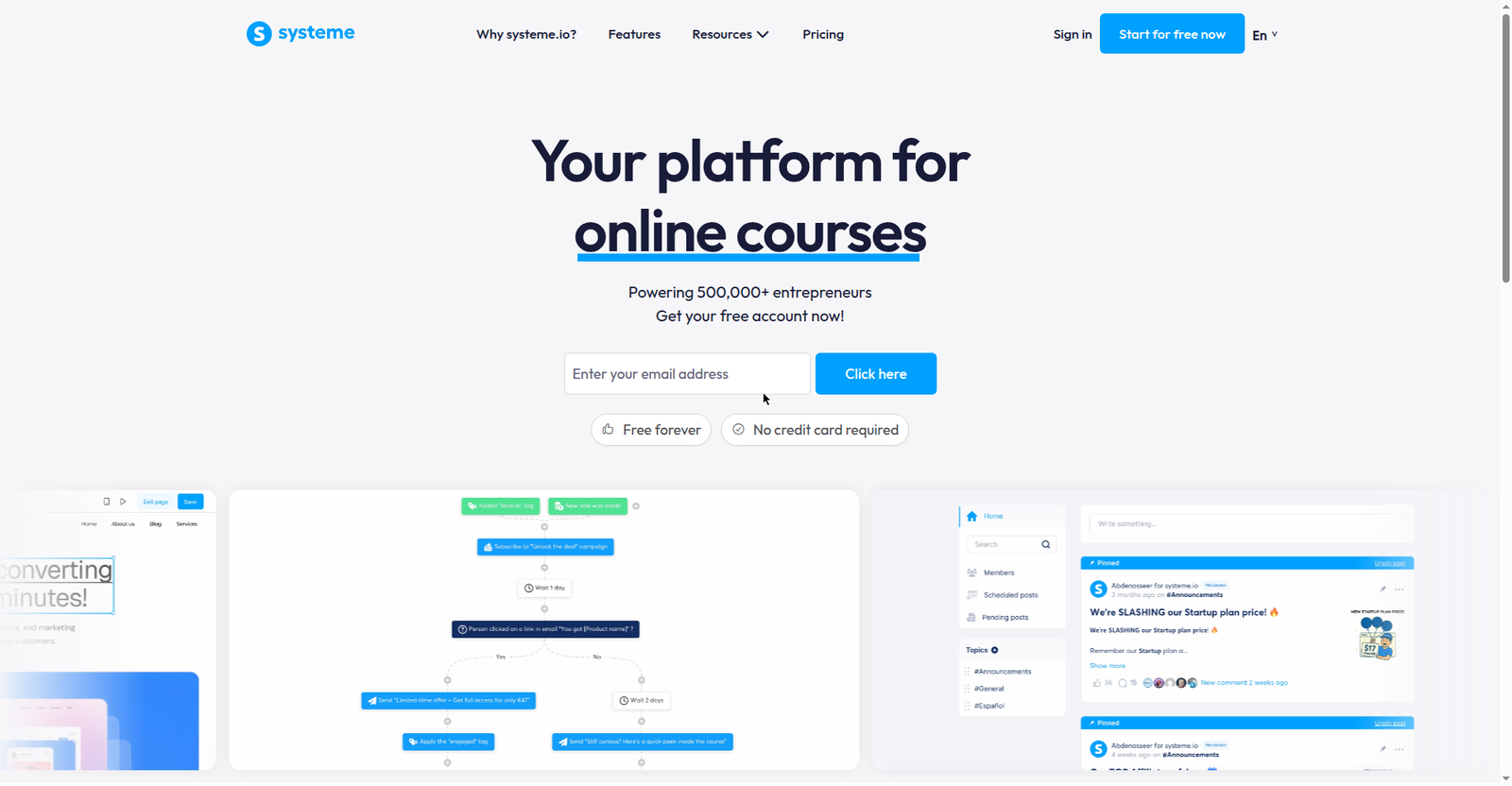 Systeme.io homepage — the free-forever plan and no-credit-card pitch are front and centre
Systeme.io’s biggest strength is that its free plan replaces several subscriptions at once: email marketing, landing pages, sales funnels, course hosting and a blog. For a startup where every extra tool is a separate bill you cannot afford, the “everything in one dashboard” model is genuinely compelling.
Pick it if: your budget is zero and you need email plus landing pages or funnels without buying multiple tools.
Skip it if: you need enterprise-grade automation or advanced deliverability reporting — dedicated email platforms go deeper there.
Automation-heavy marketing → GetResponse
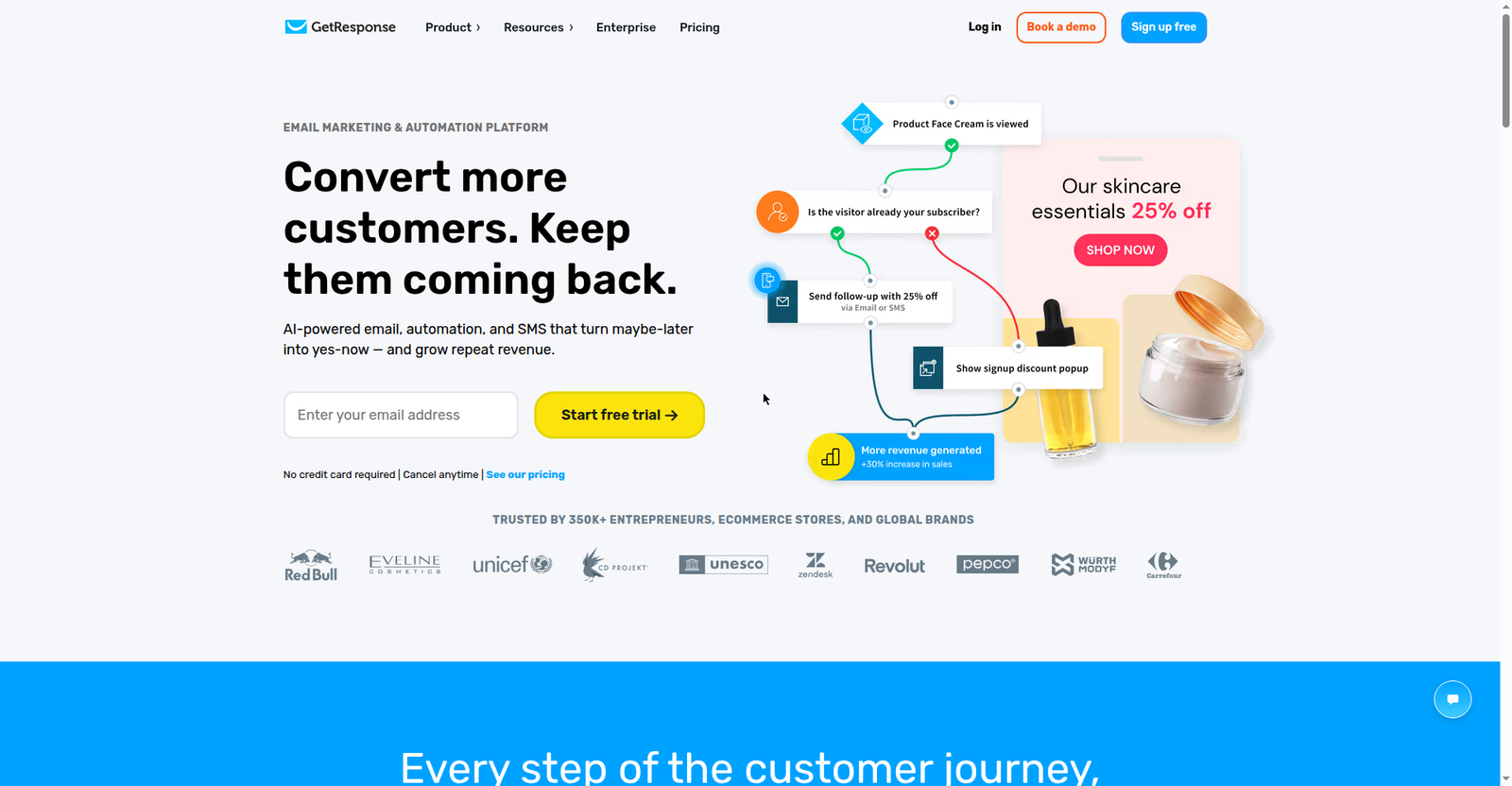 GetResponse homepage — automation and webinar features lead the pitch
GetResponse is the mature, feature-rich option. Advanced automation workflows, webinar hosting (100 attendees on the Creator plan), detailed segmentation and ecommerce features like abandoned-cart recovery. There is a learning curve, but the depth is real for power users.
Pick it if: you plan to run webinars, build multi-step automation journeys, or need deep segmentation for ecommerce.
Skip it if: you are still in the validation phase and simplicity matters more — all those features can overwhelm a solo founder early on.
Try GetResponse — evaluate its workflows and webinar features on the free tier first.
The upgrade playbook: when to start paying
Here is the strategy most successful small businesses follow:
Phase 1 — Validation (0 to ~500 subscribers). Stay on a free plan. Your only job here is to prove people open and read your emails. Spending money before the list is validated buys you nothing.
Phase 2 — Traction (~500 to 2,000 subscribers). When you start hitting free-tier limits — contact caps, send caps, or a missing automation feature — move to the cheapest paid tier. By this point you already know which tool fits your workflow.
Phase 3 — Growth (2,000+ subscribers). Now invest in automation: welcome series, abandoned-cart emails (if ecommerce), re-engagement campaigns. At this stage the tool’s cost should be a small fraction of the revenue the list generates.
Golden rule: do not spend heavily on the tool until the list produces earnings or measurable business value. And when you do upgrade, check annual billing — it is typically 15–20% cheaper (confirm the exact discount on the official pricing page).
Affiliate transparency (public programme info)
Since this is an affiliate site, here is what these tools’ public affiliate programmes pay — so you can judge for yourself that our recommendations are not driven by commissions:
- GetResponse affiliate (official, verified): 33% recurring commission by default, rising to 40–50% at higher sales volumes.
- Systeme.io affiliate (official, verified): 60% lifetime recurring commission on every subscription sale.
- Kit affiliate (third-party reports): 30% recurring for 24 months.
These are public programme facts, not earnings hype. The recommendations above are based on features and startup fit — not on commission rates.
Running a local business too? Pair email with a website
If alongside your startup you also run a local business — a salon, clinic or coaching centre — an email list works best together with a simple website. Our guide on hosting for small business websites covers budget hosting options, and the interactive hosting comparison tool lets you compare plans side by side. If you are costing out a first website, our website cost calculator gives you the full year-one math, and bloggers can read the complete WordPress blog cost breakdown for 2026.
How we evaluated (methodology)
Free-plan limits and paid-plan prices cited above come from third-party 2026 reviews and reads of official pricing pages (emailtooltester.com, sendx.io, referralsvc.com’s read of getresponse.com/pricing dated 2026-09-07), plus the affiliate-program facts recorded in our research notes on 2026-10-09 from official programme pages. Where sources conflicted — Kit’s free-plan automation access, Systeme.io’s exact paid-tier prices — we said so instead of picking a winner. We received no free access or payment from any company mentioned. When you buy through our links we may earn a commission at no extra cost to you — see the disclosure box on this page.
Final word
The biggest mistake in email marketing is hunting for the “perfect tool.” The truth is all three tools work — the only thing that matters is which stage you are at today:
- Starting today, spending nothing? → Systeme.io’s free plan.
- Newsletter-first, want it simple? → Kit.
- Need serious automation and webinars? → GetResponse.
Do not spend a week choosing a tool. Decide in a day, start writing your first email the next. Because an email list’s real value is not in the tool — it is in consistency.